Reviewing plan & cost
Read an OrkStage plan before you deploy. Placement per provider, policy results, connectivity across clouds, monthly cost, the diff and its risk.
The Plan & cost tab of an instance runs a preview (POST /instances/:id/preview). The preview
compiles the template with the instance's variables and placements, then compares the result with
what OrkStage already knows about the instance. It never touches a cloud and saves nothing.
Placement
The preview lists every resource with the target, region and concrete capability it resolved to,
for example database → Azure Database for PostgreSQL Flexible Server (eastus). When a capability
is not available in a region, the preview fails and suggests alternatives.
Policies
Every policy reports a result, so you see everything that was checked, not only what failed:
| Policy | Checks |
|---|---|
no-public-database | No database has publicAccess: true. |
no-public-storage | Object storage blocks public access. |
production-backups | Production databases have backups enabled. |
non-production-template | Sandbox templates are not used for production. For other environments it only warns. |
encryption-required | Every chosen capability supports encryption at rest. |
allowed-regions | The target and the platform both allow each region. |
max-replicas | Replica counts stay under the platform limit, when one is configured. |
max-monthly-cost | The estimate stays under the monthly budget, when one is configured. |
multi-cloud-allowed | The MULTI_CLOUD and MULTI_REGION feature flags allow several clouds, or several regions of one provider, when the placements use them. |
cross-cloud-connectivity | Links between clouds can be satisfied. Warns about latency and egress. |
approved-machine-sizes | Every service uses an approved size (vCPU and memory), when sizes are configured. |
approved-registries | Every service image starts with an approved registry prefix, when registries are configured. |
required-labels | The instance carries every required label. |
minimum-tls | Load balancers accept only the configured TLS version and newer. Enforced on AWS; a warning on providers where OrkStage cannot set it. |
mandatory-logging | Service logs are kept at least the configured number of days. Enforced on AWS (CloudWatch, rounded up to an accepted period); a warning elsewhere. |
A fail result blocks the deployment. Custom templates go through the same policies.
Policies as data
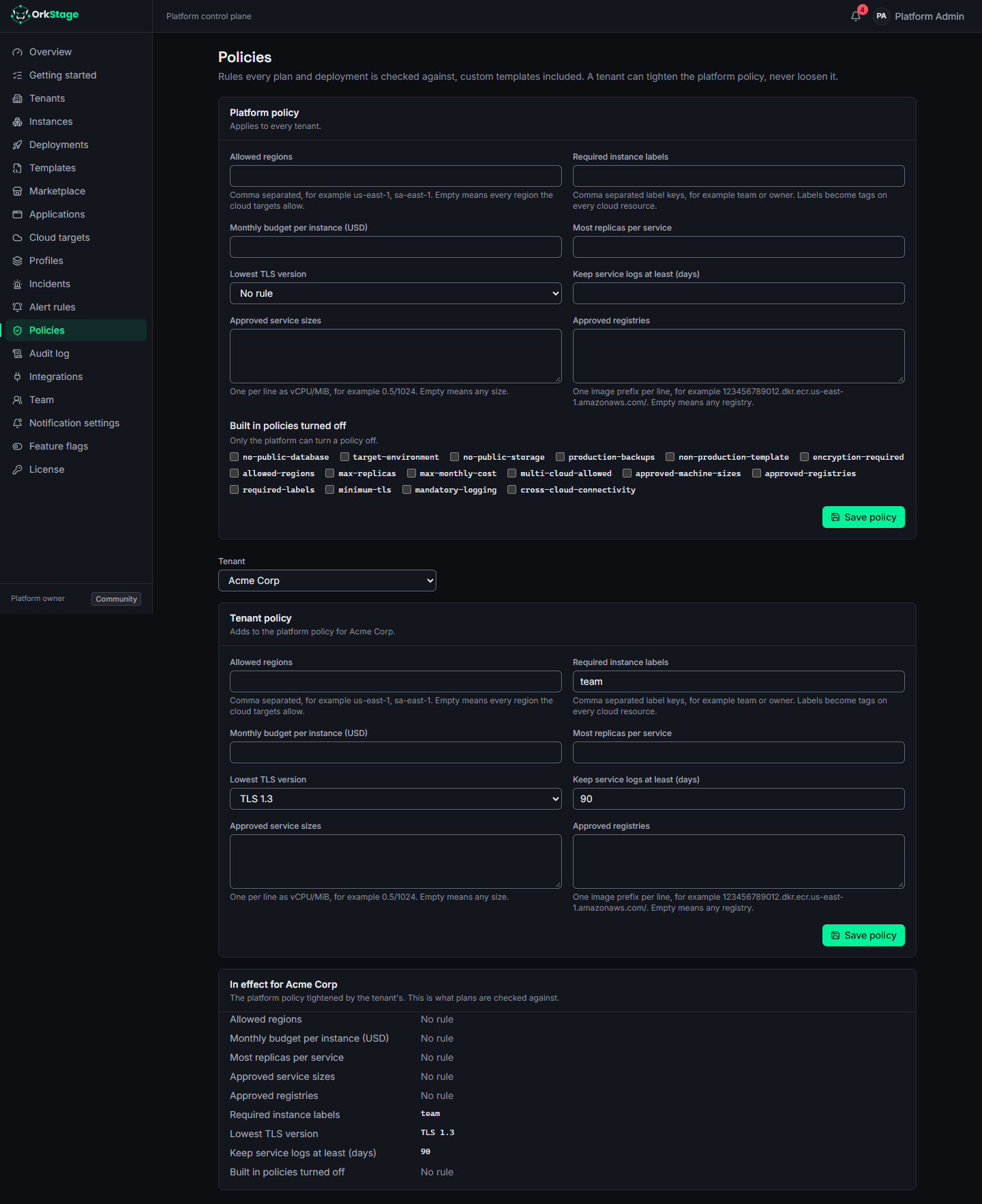
The values behind these policies are data, set on Policies in the console or through the API:
- Platform staff set the platform policy (
GETandPUT /policies). It applies to every tenant and is the only place where a built in policy can be turned off. - Tenant owners and admins set their tenant's policy (
GETandPUT /tenants/:id/policy). It can only tighten the platform policy: regions, sizes and registries narrow, budgets and replica limits go down, required labels add up, and the TLS version and log retention go up.
The page also shows the policy in effect for the tenant, which is what every preview and deployment is checked against. API keys cannot change policies.
{
  "allowedRegions": ["us-east-1", "sa-east-1"],
  "machineSizes": [{ "cpu": 0.5, "memoryMiB": 1024 }, { "cpu": 1, "memoryMiB": 2048 }],
  "approvedRegistries": ["123456789012.dkr.ecr.us-east-1.amazonaws.com/"],
  "requiredLabels": ["team"],
  "minTlsVersion": "1.3",
  "minLogRetentionDays": 90
}
Instance labels
Labels are key and value pairs on an instance, edited on its Overview tab or sent as labels when
it is created or updated. They become tags on every cloud resource of the instance, next to the
platform tags (which win on a clash and whose platform prefix is reserved). A policy can require
some of them, for example team, so every resource can be traced to its owner and cost center.
Connectivity
For each connectivity requirement in the template, the compiler chooses a strategy:
| Strategy | When |
|---|---|
private-network | Both resources are in the same target and region. |
private-peering | Same provider, different account or region. Peering cost and setup apply. |
public-tls | The requirement's mode is secure: TLS over the provider network or the public network. |
public-tls-allowlist | Across clouds with private-preferred: TLS on a public endpoint that allows only listed sources. |
unsatisfiable | Across clouds with private-required. Change the mode or the placement. |
OrkStage never creates VPNs or interconnects without telling you. Links between clouds add latency and may incur egress charges, and the preview says so.
What OrkStage wires for a link between clouds
The plan shows, for each link between clouds, what OrkStage does besides choosing the strategy:
Cross-cloud
CONFIGURE api → database (public-tls-allowlist); credentials copied to api's secret store; firewall allows network egress only- Credentials. When the consumer runs on AWS, Azure or Google Cloud and the database lives on
another provider, OrkStage reads the database credentials from the provider that owns them and
copies them into the consumer's own secret store at deploy time: one Secrets Manager secret on
AWS, Container Apps secrets on Azure, Secret Manager on Google Cloud. The service receives them as
<ID>_USERNAME,<ID>_PASSWORDand so on. The values pass to OpenTofu as a sensitive variable and never appear in the stored configuration. On other providers the service receives only the reference,<ID>_CREDENTIALS_REF, and reads it at start. - Allowlist. For
public-tls-allowlist, the database waits for the consumer's network and its firewall allows only that network's egress addresses: Azure PostgreSQL firewall rules (replacing the rule that admits every Azure service) or Cloud SQL authorized networks. The network needs a NAT gateway (natGateway: true) for a fixed egress address; the plan says so when it has none. PostgreSQL on AWS and OCI has no public endpoint, so a consumer on another cloud cannot reach it without a VPN or interconnect, and the plan says that too. - Verification. After the deployment, each link is reported with its wiring and whether both ends are healthy. The worker sits in neither network, so it does not probe the path between them; check it from the application (a connection test at start) when it matters.
Cost estimate
The estimate uses static list prices from each capability catalog (on demand, monthly, in USD). It
is always labeled approximate and is not an invoice. Its confidence is approximate when every
resource has a price, partial when some do not, and unavailable when none do. Lines are grouped
by category: compute, database, cache, storage, network and messaging.
The plan and its risk
The diff against known resources lists each resource as CREATE, UPDATE, DELETE or NOOP,
grouped by provider, target and region. A change of target, region or capability counts as a
replacement. Approval requests and logs use the same plan in plain text:
Deployment Plan

Instance: Acme Production

AWS / aws-prod / us-east-1
  CREATE Amazon VPC network
  CREATE Amazon ECS on Fargate api
  CREATE Application Load Balancer ingress

AZURE / azure-data / eastus
  CREATE Azure Database for PostgreSQL Flexible Server database

Cross-cloud
  CONFIGURE api → database (public-tls-allowlist)

Risk: low| Risk | When |
|---|---|
high | Anything is deleted or replaced, or an existing database changes. |
medium | Existing resources are updated. |
low | The plan only creates resources, or changes nothing. |
The preview shows the platform's view. During the deployment, the worker also runs the real provider plan for each resource that changes. See Deploying.
Creating an instance
Create an OrkStage instance with the six step wizard. Pick the tenant and template, bind each slot to a target and region, then set variables.
Deploying and watching progress
Start an OrkStage deployment and follow it live. Approve high risk production changes, cancel, retry failed resources, upgrade and destroy safely.